A community almanac from Pemberton, Lil'wat, Area C and N'Quatqua.
More poetic attitude please
A recent conversation with some friends about tech led to a response: we need to slow this down.
“Thanks to the powerful taboo against slowness, even just thinking about slowing down makes us feel afraid, guilty or ashamed. Add to that the fear of being alone with our thoughts. Speed is often an instrument of denial,…we distract ourselves with speed and busyness.”
I’ve long been inspired by the idea of velocity, and that everything has its own velocity, which is defined by capacity.
“There is an appropriate velocity for water set by geology, soils, vegetation, and ecological relationships in a given landscape. There is an appropriate velocity for money that corresponds to long-term needs of communities rooted in particular places and to the necessity of preserving ecological capital. There is an appropriate velocity for information, set by the assimilative capacity of the mind and by the collective learning rate of communities and entire societies. Having exceeded the speed limits, we are vulnerable to ecological degradation, economic arrangements that are unjust and unsustainable, and, in the face of great and complex problems, to the befuddlement that comes with information overload.”
David Orr (quoted in Woody Tasch’s Inquiries into the Nature of Slow Money)
So this idea, shared by Minna Salami, over at advaya.co, that we need to pair our scientific attitude to the world, with a Poetic Attitude, naturally appealed to me. It also made me think of Leigh Joseph and Robin Wall Kimmerer and some of the writers who have altered my thinking so profoundly about the natural world, because they bring science and poetry together. They offer both – a dance between the scientific and the poetic, that creates some kind of emergent space, that brings things to life in a new way.
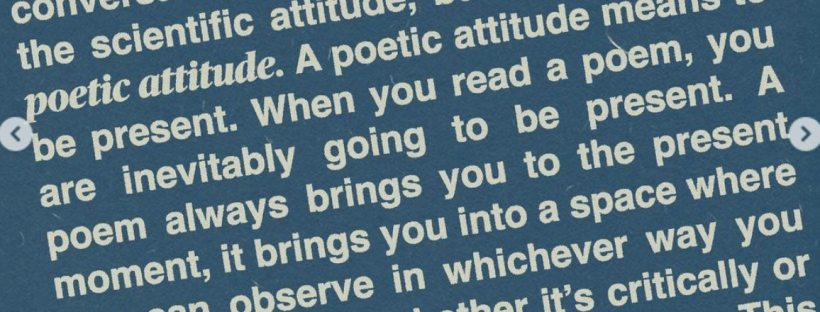
Whenever philosophers, thinkers, activists, artists, people who are engaged with social commentary, try to analyze the many problems that we face in the world, they typically say that there’s a problem with the system: the institutions that shape our lives, and structures like white supremacy, patriarchy or classicism. Of course that’s true, but on a deeper level, I’m arguing that the problem is knowledge itself. Intellectual institutions keep producing the same problems over and over again. When we have new technologies, new conversations or new institutions, we reproduce the same problem. The internet and social media held so much promise when they first launched; people truly believed they were going to transform society. But what we see now is that we not only reproduced, but even have increased many of the same problems that already existed. That is because the very intellect and knowledge systems, the way of knowing that underpins these technologies, is flawed, divisive, and robotic. It is lacking in soul. Euro-patriarchal knowledge separates between things that should be in conversation with one another. We need the scientific attitude, but we also need the poetic attitude. A poetic attitude means to be present. When you read a poem, you are inevitably going to be present. A poem always brings you to the present moment, it brings you into a space where you can observe in whichever way you need to observe, whether it’s critically or compassionately or intimately. This presence is an awareness that the scientific attitude doesn’t cultivate.
“I have an image for the time we are living in. It’s like being in a house that is rectangular shaped and very long, and on both ends of the house, there is a window. If you look out of one window, you see a beautiful park, maybe a city or urban landscape, you see something that’s quite compelling. You’re drawn to that. But then if you look out at the other window, you see a fire, you see a tremendous breaking down and social anomie.
There’s quite often this incentive to just look from the one window at the beautiful view and focus on that inner world that can be cultivated in that space, while the other side is on fire. Whereas with this image in mind, you’re brought into the present and what the present looks like. Yes, there is beauty, and it’s very important that we do beauty and we evolve internally. But it’s also very important that we are aware of the suffering around us and the ways that we are being encouraged to become blind to that suffering.
That is precisely why the euro-patriarchal knowledge is more than just a formulaic approach, it has an agenda. That agenda is to make us blind to the suffering in order for euro-patriarchal knowledge to continue to dominate and thrive. If euro-patriarchal knowledge is blinding us with its whitewashing, obscuring, and perpetuating propaganda that biases European Eurocentric maleness, then bold thinking is speaking truth to power and not allowing it to espouse lies.”
– Minna Salami, on an interview in Evolve Magazine 💭

 The Wellness Almanac