
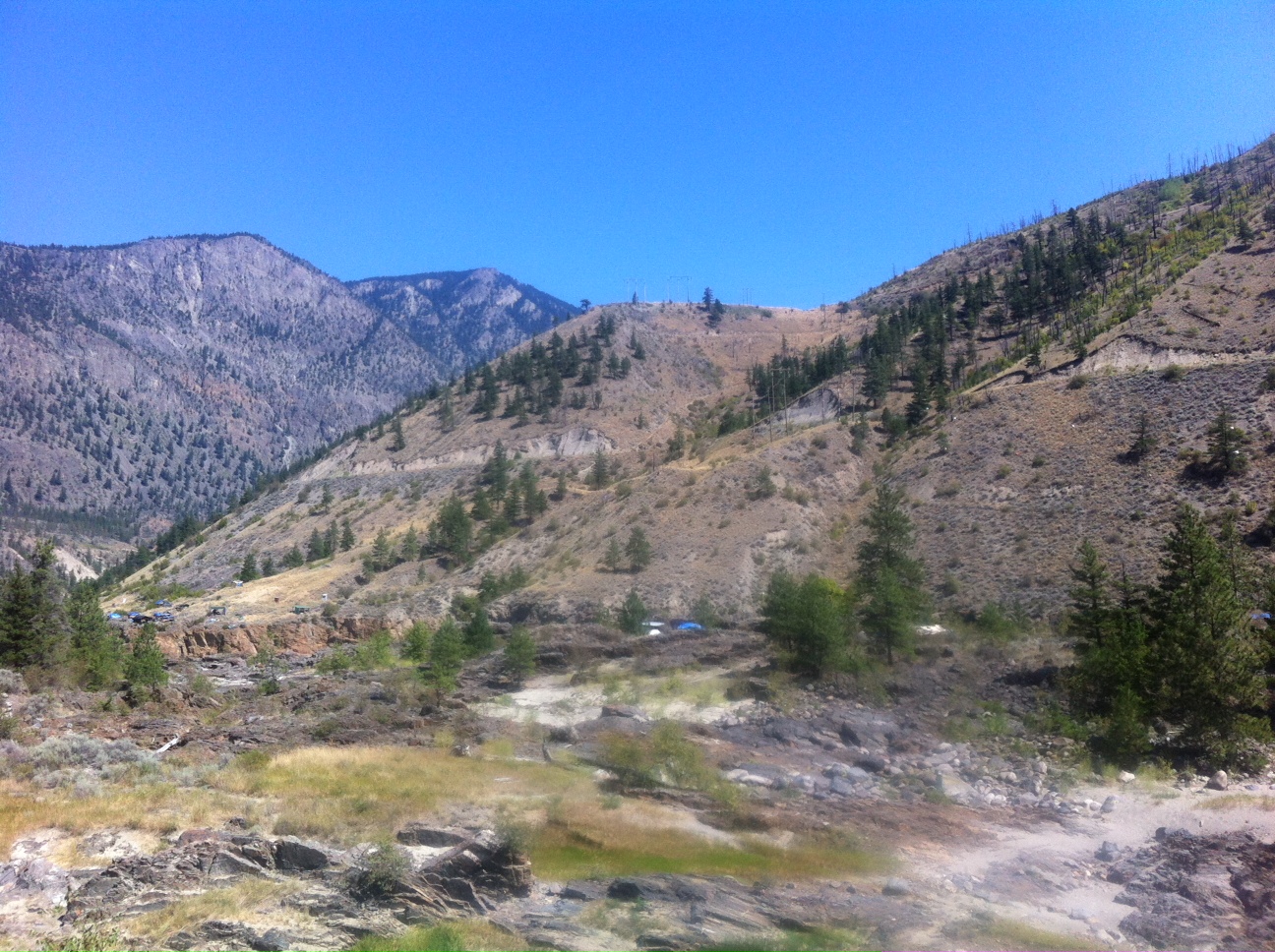
If you look closely you can see the blue tarps covering the wind-drying racks of fish camps set up along the Bridge and Fraser Rivers for the salmon run right now.
Tomorrow is the Slow Food Cycle which, for 10 years, has celebrated Pemberton’s agricultural story and its producers, the families living on the land, as stewards and growers.

It was founded with a desire to help bridge the gap between town folk and country folk, growers and consumers, people and the land, and bring us all into closer relationship – because the skills and practice of knowing intimately where one’s food comes from aren’t lost. They’re just uncommon.
A stop at Lillooet Airport Gardens on Sunday led me to the Bearfoot Grill on the Bridge River Fishing Grounds, just 6km past Lillooet, on the confluence of the Bridge River and the Fraser River, where those skills are being practiced right now, as a healthy salmon run makes its way up the Fraser River. The fish camps are set up along the river, where families are harvesting and drying salmon, and you can glimpse them from the shade of the Grill.
According to cayoosh.net, it was the hand-crafted bridges constructed by the First Nations to access the fishing spots that lent the Bridge River it’s name.


|
The Bridge River community opens the fishing rocks to all St’át’imc members across its nation, and quite a few Mt Currie families have headed up to fish.
An interpretive tour for visitors also runs out of the site.
In the same way that Slow Food Cycle is a celebration of farms, thanks to the generosity of growers who open the gates to share the day with visitors, a stop by the Bearfoot Grill for a burger, snack or coffee is a pretty amazing opportunity to catch a glimpse at another set of relationships playing out.
Be sure to check out Richenda Grafton Joe’s great column about the impact the Mount Polley mine tailings spill will have on the Lillooet fish camp:
Tragically, we as First Nations are often viewed as radicals when we take our fight against the government to a public level. All we are doing and have been doing for centuries is fight for Mother Earth. Not to claim ownership but to live up to our guardianship of the land as bestowed upon us by the Creator. It is and always has been the responsibility of the red-skinned humans to protect and preserve our Mother Earth as best we can. Since a time immemorial we have lived off the land while giving back to it as much as we take from it. It is our collective belief that we are one with the land that provides for us, so we must reciprocate and take care of what we are given. Any gardener will tell you the same thing; if you want to continue to receive a healthy harvest then you must do the work to preserve and nourish the habitat which provides that outcome. How is that in any way to be perceived as radical? It seems simple enough.
This disaster and others are the exact reason why we continue to fight for our land, it’s a good fight. We will continue to fight this fight regardless of how we are perceived. We are fighting this fight not only for ourselves but for future generations of all races, creeds and beliefs. We can only hope that the remaining masses will join us in this uphill battle and help others open their eyes to their destruction. – See more at: http://www.whistlerquestion.com/opinion/columnists/lil-wat7ul-ts-ila-ts7a-fighting-the-good-fight-for-the-salmon-and-ourselves-1.1308178#sthash.NxHNLY4C.dpuf

 The Wellness Almanac