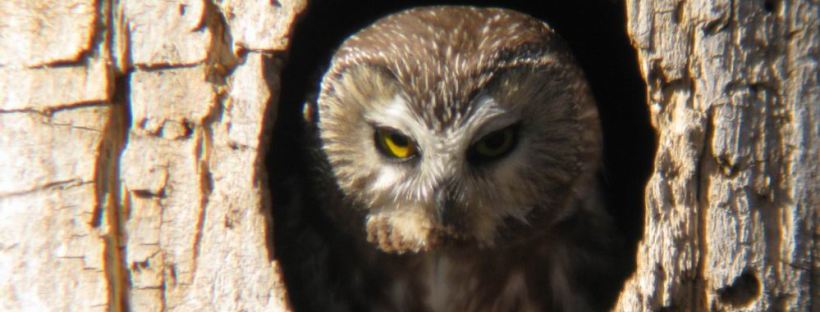
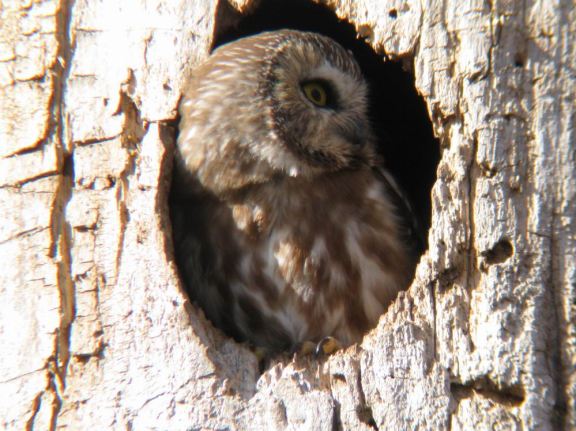
Earlier this spring, Stewardship Pemberton reported hearing the call of the northern saw-whet owl in the ‘hood.
The Saw-whet Owl’s name comes from the “skiew” call that is made when alarmed. This sound has a resemblance to the whetting of a saw. (Follow this link to listen to the call – a series of whistled toots.)
Now, thanks to local birder John Tschopp, we have a face to put to the voice – a good sighting given that northern saw-whet owls are strictly nocturnal, with activity beginning at late dusk. (Their excellent low-light vision allows them to easily find prey by night at sight. They eat deer mice, shrews, voles, young squirrels, small birds, and large insects.)
Saw-whet owl males choose and defend territories and call to attract females. The females choose the nest cavity, often an old nest hole made by a Northern Flicker or Pileated Woodpecker.
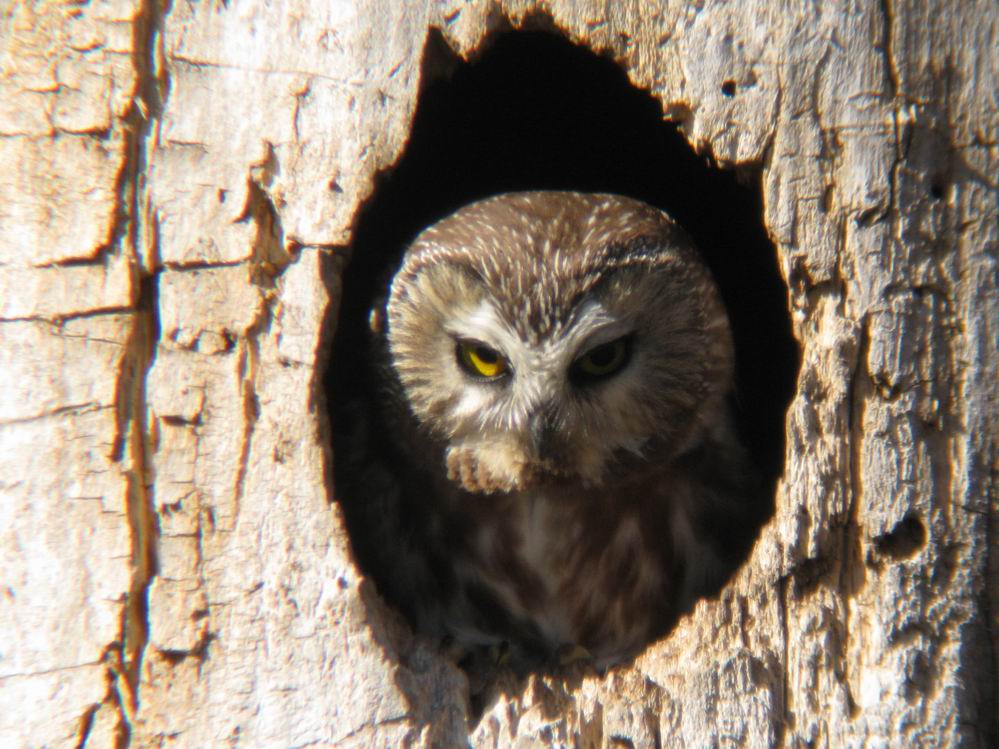
That’s where John spied this owl… a cavity in his cottonwood stand where a pileated woodpecker raised a brood back in 2010.
John also notes:
the ability of owls to control the pupil of each eye individually. [In this photo] the pupil on the sunny side of the face is way smaller than the one on the shady side. Let’s hope the owl has a partner to form a breeding pair.
The female Northern Saw-whet Owl does the incubation and brooding. The male brings all the food needed while the female is incubating the eggs. She leaves the eggs for only one or two short trips each night, to defecate and cough up a pellet.
The incubation period is 21 to 28 days. Young fledge at 4 to 5 weeks, and may leave the nest individually every 1 to 2 days, until they have all left. The young owls are cared for by the parents for some weeks after they leave the nest.

 The Wellness Almanac