Last month, I took part in a 30 day journaling challenge from the Good Grief Network, a climate capacity building organization, whose founder I ALMOST got to teach with, at Hollyhock, this summer. (The program was cancelled 😦 Fingers crossed for what emerges from the compost.) I was so impressed with the way LaUra Schmidt showed up in zoom planning meetings, I bought her book as soon as it was available, and was keen to see what a heart-centred climate-resilience journaling adventure would look like. (I’d recommend it.)


One day, we were sent this poem as our prompt.
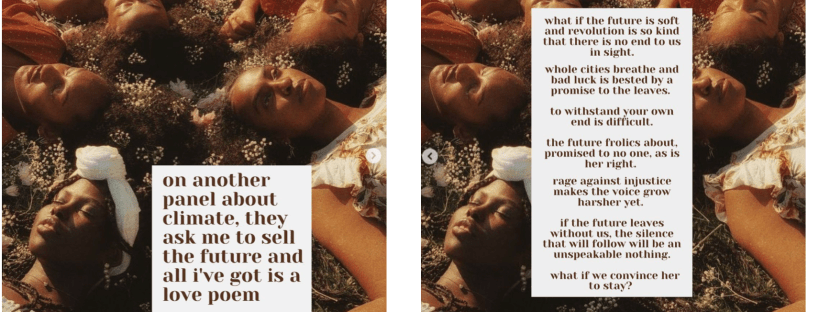
ON ANOTHER PANEL ABOUT CLIMATE, THEY ASK ME TO SELL THE FUTURE AND ALL I’VE GOT IS A LOVE POEM
by Ayisha Siddiqa
What if the future is soft and revolution is so kind that there is no end to us in sight.
Whole cities breathe and bad luck is bested by a promise to the leaves.
To withstand your own end is difficult.
The future frolics about, promised to no one, as is her right.
Rage against injustice makes the voice grow harsher yet.
If the future leaves without us, the silence that will follow will be an unspeakable nothing.
What if we convince her to stay?
How rare and beautiful it is that we exist.
What if we stun existence one more time?
When I wake up, get out of bed, my seven year old cousin
with her ruptured belly tags along.
Then follows my grandmother, aunts, my other cousins
and the violent shape of their drinking water.
The earth remembers everything,
our bodies are the color of the earth and we
are nobodies.
Been born from so many apocalypses, what’s one more?
Love is still the only revenge. It grows each time the earth is set on fire.
But for what it’s worth, I’d do this again.
Gamble on humanity one hundred times over
Commit to life unto life, as the trees fall and take us with them.
I’d follow love into extinction.
– – –
Journal on these questions or any lines from the piece:
The future frolics about, promised to no one, as is her right.
What if we convince her to stay?
Love is still the only revenge.
– – –
What would you follow into extinction?
What is “kind revolution” in your heart?
I honestly didn’t even know what to do with those prompts. Much of the journaling journey left me mostly gobsmacked.
What would I follow into extinction?
“Been born from so many apocalypses, what’s one more?” I think about this line. I spoke with a creative group I’m part of, a Thrutopian writing collective, at the beginning of the year. It’s international, but based out of the UK and it’s predominantly a group of white-bodied people, and I wanted to say, we get stuck in this way of thinking that we are facing the first apocalypse ever, on Earth, that no-one has done this before, and yet, most people of colour have “been born from so many apocalypses, what’s one more?” And probably, if we can re-claim or re-member, the histories we came from, back far enough, when we white-bodied folk were indigenous somewhere too, there are displacements and climate calamities and plagues and life-ending events, in our genetic memories too. The Thrutopian creative community is made up of writers and poets trying to create storylines that will help people find their way through, to a more beautiful future, and to find solutions for this strange collapse we’re bringing about, and I wanted to say, keep in mind, we are not the first. There are teachers of this work, all around us. Every Lil’wat and N’quatua person I’ve interviewed has a memory of apocalypse in them, in their lived stories, in their grandparents’ lives, in their own, and the creative, courageous responses and solutions are right here, and we shouldn’t overlook them. We can listen and learn how to contend with what we’re facing, how to carry ourselves, how to carry each other.
“Love is still the only revenge.”
The poem’s author, Ayisha Siddiqa is a Pakistani Climate justice advocate living in Coney Island, NY, a coastal area highly prone to hurricanes and floods. She is a co-founder of Polluters Out and the Executive Director of Student Affairs at FFU. On Sept 20th, 2019 she helped mobilize and lead over 300,000 students onto the streets of Manhattan demanding their governments take climate action.
She’s 24. She’s a Climate Advisor to the UN General Secretary. She was named one of Time’s Women of the Year in 2023.
Inspired by Padraig O’Tuoma’s On Poetry podcast, and my friend Mary, a poet, who said to me recently that she thinks we turn to poetry when words fail us, essentially, in the most challenging times, AND by my personal challenge for this month (thanks for the relentless arm-twisting, Asta), the Capra 30×30 challenge to get out and run/walk/be outside, and how much I enjoy pairing that trail time/forest time, with some good listening, I thought to offer some Poetry Appreciation that you could listen to.
Morsels, of goodness.
I’ve enlisted a few of my favourite voices, who by coincidence, share an appreciation for poetry, to get the ball rolling. And I’d love for you to take part to. Grab a poem, any poem. One you wrote. One you’ve memorized. One you just discovered. Hit record on the voice memo button on your phone, tell us who you are, and what feels alive for you in this moment, and read us the poem.


Here’s mine:
And for more on the glorious poet behind it, here’s the Time story.

Time’s KYLA MANDEL wrote:
When Ayisha Siddiqa talks about poetry, her face lights up. For the 24-year-old Pakistani human rights and climate defender, poetry represents hope—a way to bring humanity back into the staid, high-level conversations that increasingly occupy her time. At the annual U.N. Climate Conference in Egypt in November, she shared an original poem titled “So much about your sustainability, my people are dying” as an unvarnished rebuke of leaders’ failure to act on climate change.
Siddiqa felt the effects of this lack of action viscerally last year as she witnessed from afar the life-altering impacts of Pakistan’s floods, likely made more extreme by global warming. She channeled those feelings into poetry as a form of protest. “It’s an effort to preserve what I have left, while I still have the time, in written form,” she says. “Art makes life worth living, and in my opinion, it’s what makes humans worth the fight. Like all of the things that we leave behind, all the creations, wouldn’t it be so unfortunate if there’s nobody on the other side to witness and observe them?”
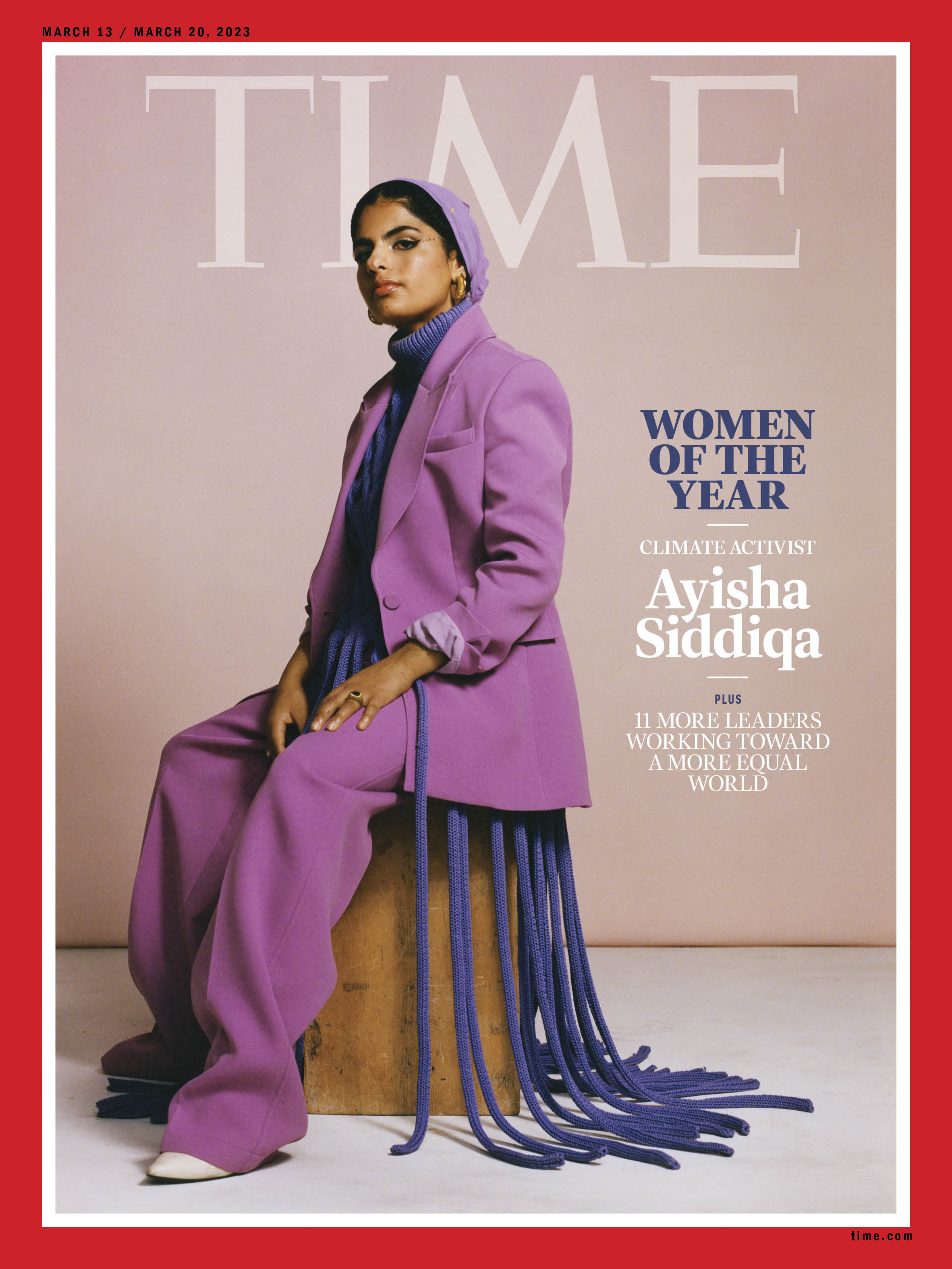
Photograph by Josefina Santos for TIME
Her mission is deeply personal. At 14, Siddiqa realized how unsafe the environment can be after witnessing the illness and death—including of her grandparents—that came from her community’s polluted river water. At 16, she experienced another awakening as she became aware of the link between human rights and climate change. Access to resources was, for some people, worth killing for, she learned. For many, demanding clean air and water meant risking their lives. Growing up in a matriarchal, tribal community in eastern Pakistan helped shape her outlook. “The wounded world is so beautiful, because she keeps producing life,” she says. “And my work is in defense of life. By default, its defense of the rights of women. Therefore, it’s also by default human rights.”
These realities and values are what motivate Siddiqa to use her voice to uplift the vulnerable and hold polluters to account. “I was raised with the idea that the earth is a living being, that she gives life to you and in return, you have a responsibility,” she says. “And I think we, collectively, have come to a point where we are ignoring the cries of earth mother.”
Read More: Meet 15 Women Leading the Fight Against Climate Change
In 2020, Siddiqa co-founded Polluters Out, a global youth activist coalition, and helped launch the Fossil Free University, an activism training course. Now, she’s working to help set up a youth climate justice fund to correct the imbalance of resources activists have compared to the fossil fuel industry—when it comes to climate action lobbying, the fossil fuel industry out-spends activists and the renewable energy sector by a factor of 10:1, according to a 2018 study. Siddiqa’s work with the nascent fund aims to better distribute philanthropic funding to grassroots activists around the world. And as a research fellow for the Climate Litigation Accelerator project at New York University’s Center for Human Rights and Global Justice, she’s helping to create a system of support that breaks down silos between intergovernmental leaders and local activists, as well as pushing to integrate the rights of humans and nature alike into climate law.
“This work is definitely intergenerational,” she says. “I am young now. Tomorrow, I won’t be. I absolutely love working with people younger than me to pass on this knowledge so that the chain never breaks.”

 The Wellness Almanac