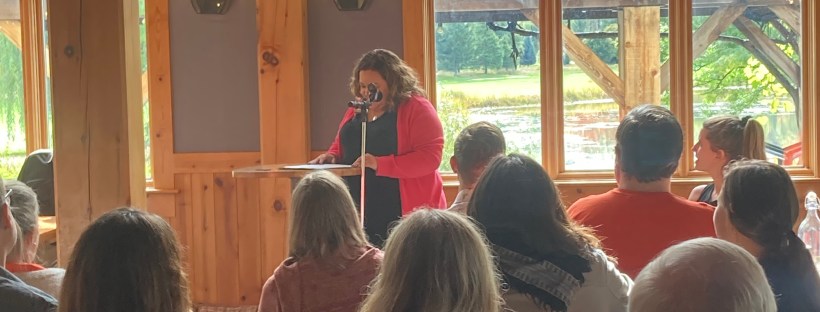
On Thursday, September 28, 2023, the Pemberton + District Chamber of Commerce hosted a “lunch and learn” in recognition of Truth and Reconciliation Week, with Skalúlmecw Chief Dean Nelson and Rosemary Stager-Wallace as the keynote speakers. Rosemary graciously agreed to let us share her words here.
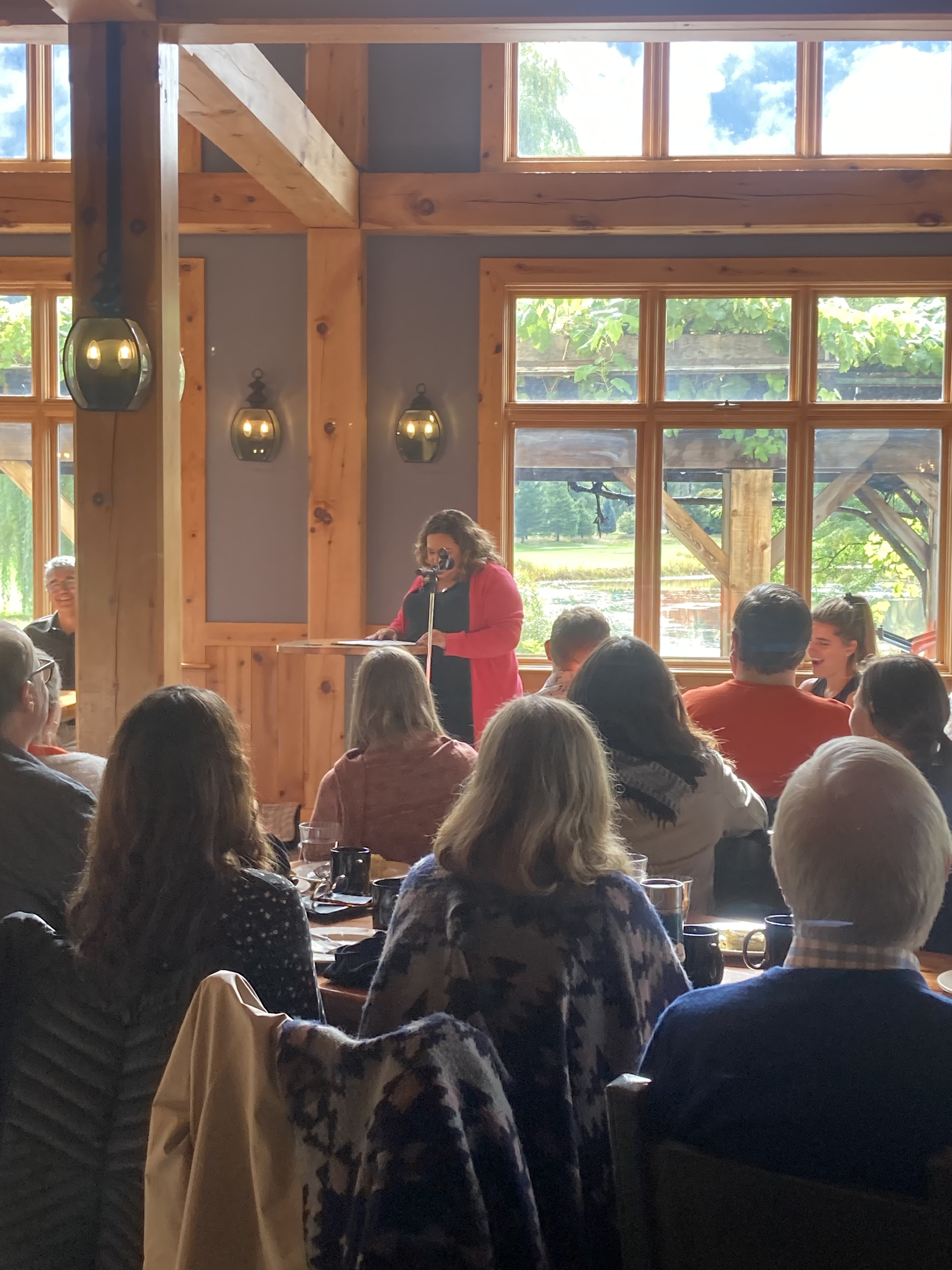
Énsta sTsekonamus Katitsa, my name English name is Rosemary Stager-Wallace, my traditional name, sTsekonamus, translates to “walk in the woods.̣” This name was passed down to me by my Grandmother Rosie Ross. Our traditional family name is Katitsa which represents the Stager family, we are one of the only families who still has our traditional family name because of a Story of the Great Flood that has been passed down for generations. This past July, I became the new CEO of the Líl̓wat Business Group.
I’d like to thank the Chamber of Commerce for the invitation to speak to all of you today as part of National Truth and Reconciliation Week.
Prior to taking this new position this summer, I was engaged in economic development with Líl̓wat Nation through my work as a member of Council.
Lifting our Nation out of poverty by building a sustainable economy, creating profitable businesses, supporting our entrepreneurs, and partnering with progressive companies has long been a passion of mine. Being able to do this work full-time is truly an honour.
I want to start by saying two things. First, non-Indigenous businesses can put reconciliation into action by entering collaborative partnerships with First Nations. And secondly, Líl̓wat is a First Nation that is definitely open for business.
You can you see the changes to Líl̓wat Nation’s business landscape when you drive through Mount Currie.
A few years ago, when we opened our new gas station, we began the process of revitalizing our commercial core, a plan that had long been in the works. Part of this plan is the development of Líl̓wat Marketplace, a two-building complex to be located on the parcel of land between Líl̓wat Station and Ts̓zil Learning Centre.
Líl̓wat Marketplace will have space accessible to Líl̓wat artisans and entrepreneurs to sell their goods and develop their businesses. The project will also have space for food services and other amenities such as public washrooms. Líl̓wat Marketplace has long been a part of the vision for a revitalized commercial core and will soon be a reality.
We have partnered on this project with Murphy Construction, with whom we have enjoyed a long and productive partnership. Líl̓wat Marketplace’s striking designs, which include an outdoor eating area modelled on the s7ístken, have been approved and we are finalizing our funding applications for submission in October.
The entrances to our community, whether approaching it from the Lake Road or Highway 99, are going to look very different in the next couple of years.
Plans are in place for a mixed residential/commercial on Main Street where the old “Blue Motel” stood. This new project, developed with BC Housing, will feature 55 units of housing and leasable store fronts.
We have also purchased the Spirit Circle building across the street. With a commercial kitchen and considerable outdoor space, this new asset presents a variety of options. Leadership is currently in discussions to determine the highest and best use of this new property for the Nation.
The Líl̓wat Business Group also has some exciting projects that are moving forward outside of the community, such as the mixed residential/commercial development we are preparing to build with our partner, the Bethel Lands Corporation, on five hectares we own in Function Junction. We are in the final approval stages for the necessary permits and will officially be launching this project early in the new year.
Earlier this year, we acquired the Outdoor School at the end of the Pemberton Valley. I am proud to say that a couple of weeks ago our first cohort of high school students from Xet̓ólacw Community School was able to use the facility as part of a one-week school Super Course designed to connect our youth with our land and our culture. For teenagers used to our digital world, it was a profound and positive experience—except for the part when they discovered there was no cell service up there.
As the new CEO for the Líl̓wat Business Group, and a Líl̓wat Nation member, I am excited about these projects and others we are considering that present opportunities us to work together. By developing equitable partnerships, we can grow both our businesses and our communities, while helping level the economic playing field.
I grew up in this area as a child of mixed heritage. My mom is from the Shier family and my dad is from the Stagers, a Hereditary Chief bloodline from Líl̓wat Nation. My brother, sisters and I were raised in Líl̓wat.
Even as a child I was keenly aware of the economic disparity within my own family.
Things looked a lot different in my friends’ and family’s homes up the Pemberton Valley than they did in the houses that my Líl̓wat family members lived in.
The homes in Pemberton were nicer. The adults had jobs and decent vehicles. Their neighbours looked like they were doing OK, too. I never really understood why this was as a child.
Meanwhile, at home on the reserve, my family and community lived lives of legislated poverty in government housing that was considered “good enough,” but was substandard to the point of being unhealthy. Poverty and its effects, from substance abuse to poor physical health, were very evident.
My moms’ parents migrated from the prairies to Pemberton, my grandfather’s family immigrated to Canada from Ireland and my grandmother’s family immigrated from England in hopes of a better life when she was just two years old. They were given land at a great price to farm up the Pemberton Valley. They became potato farmers, building a family farm with the potential for creating intergenerational wealth.
My father’s people have lived on this land since time immemorial, a time that carbon-dating has confirmed to be at least 5,500 years. Despite living here forever, they did not own land that could be inherited by future generations. That land was owned by “the crown” and “reserved” for Indians. The most common mechanism for the transfer of intergenerational wealth had effectively been denied with the introduction of The Indian Act.
We do not get free homes, and we yes, we do pay mortgages, but our access to capital is much less than that of other Canadians. Our homes have zero value and or equity.
It is not an exaggeration to say that my Líl̓wat family was devastated by the impacts of colonialism.
Instead of being raised in a loving home surrounded by family, my dad, Chief Allen Stager, spent his childhood and youth in Indian Residential Schools from the age of five.
It was not until I was an adult, with nearly grown children of my own, that I fully understood the atrocities that he—and countless other members of my community—had faced as a child.
I learned about the roots of his trauma while helping him with his residential school settlement paperwork. It was heart-breaking and sickening to hear the daily, compounded trauma the children had to endure during their school years.
Residential schools had a mission “to take the Indian out of the child” and were key to implementing The Indian Act.
This horrible piece of legislation, which would later be adopted by South Africa as the blueprint for Apartheid, was passed before the federal government was even aware of the existence of Líl̓wat Nation.
Once the federal government knew we were here, they took our land and set about attempting to destroy our language, our culture, and the economy that had sustained us for countless generations.
The people of Líl̓wat Nation were traditionally business minded. Before colonization, we enjoyed a thriving economy, trading within the St̓át̓y̓emc Nation, other First Nations, and settler communities. We sold our services and whatever we caught, grew, harvested, or manufactured, to whoever wanted to buy these things.
Before the Indian Act was put in place, we lived on, and benefitted from the resources of, our traditional territory.
We foraged, fished, and hunted in an area encompassing almost 800,000 hectares—or almost 2 million acres—north from Rubble Creek to Gates Lake, east to the Upper Stein Valley and west to Toba Inlet on the Pacific Ocean. To put this into perspective, Líl̓wat Nation’s traditional territory is roughly one-quarter the size of Vancouver Island.
With the creation of Indian Reservation #1, known as the Old Reserve, the Crown allocated less than 80 hectares—or 200 acres—of swampy land that was subject to flooding for our entire community to live on.
At that same time, the Crown was gifting each settler who chose to live in rural Canada with 160 acres, or a quarter-section of land—enough to start a reasonably-sized farm, as my mom’s family had done.
Additionally, racism often kept us from being hired when we applied to work at non-Indigenous businesses.
As if residential schools, reserves, and racism weren’t damaging enough, the Crown amended the Indian Act in 1880 to effectively exclude us from participating in the Canadian economy.
Suddenly, permits were necessary to carry out the economic activities we had taken part in for literally thousands of years. Making things worse, commercial licenses for fishing and other businesses were largely given to non-Indigenous operators.
Non-Indigenous people faced fines and prison terms for buying from unlicensed Indigenous individuals or business.
As Indigenous people, we were not only required to have permits and licenses to sell our good and services, but we also needed permits to BUY our food, clothing, and other necessities.
Whether we were selling or buying, the message was clear: “You don’t belong here.” The Canadian economy had no place for us in it.
Excluded from participating in the economy, our people, who had for thousands of years prized their independence, became dependent. As opportunity was stripped away, so was motivation. Without a sense of purpose, people faltered.
While nearby Pemberton and Whistler prospered, Líl̓wat Nation continually fell behind, relying on inadequate government funding to maintain inadequate community infrastructure. This is a story shared by the majority of Indigenous communities across the country.
Happily, things are changing and will continue to change.
For the past 20 years, the Líl̓wat Business Group has been focussed on building a sustainable economy for the community.
Today, the Líl̓wat Business Group conducts its work though four departments: Capital Assets, Construction Enterprises, Forestry Ventures, and Retail Operations.
We operate profitable, businesses on-reserve such as Líl̓wat Station and Tsípun Market.
We manage forestry tenure and provide contracted forestry services including fuels management work and firefighting.
And we are engaged in construction and development partnerships such as Nkwúkwma in Pemberton and the previously mentioned Function Junction development in Whistler.
We are in negotiations on new projects and in the planning stages for others. We have a number of parcels of land in Whistler and Pemberton and are contemplating appropriate development.
At Líl̓wat Business Group, when we consider new ventures, we first consider the needs of our community and our people.
Every year, we give $600,000 to Líl̓wat Nation governance to directly support community initiatives.
The business group currently provides full-time jobs for more than 100 people working in our various operations. Through our partnerships, we also provide project-based employment and training opportunities, including Red Seal-certified apprenticeships, to Nation members.
The Líl̓wat Business Group is taking its rightful place at the business table, developing equitable partnerships, and creating projects designed to support a growing economy.
Increasingly, non-Indigenous businesses are seeing the value of partnering with us. There are some great reasons for this, as outlined in the following figures from the Canadian Council for Aboriginal Business.
As of the last census in 2016, there were more than 50,000 Indigenous businesses annually contributing more than $30 billion to the Canadian economy. And Indigenous people are creating businesses at nine times the rate of non-Indigenous people. This tells me that Indigenous people are business-minded people.
In 2015, Truth and Reconciliation’s 94 Calls to Action were released. The 92nd Call to Action pertains to economic reconciliation. It reads:
“We call upon the corporate sector in Canada to adopt the United Nations Declaration on the Rights of Indigenous Peoples (UNDRIP) as a reconciliation framework and to apply its principles, norms, and standards to corporate policy and core operational activities involving Indigenous peoples and their lands and resources.”
In part, the UNDRIP calls for businesses to commit to creating opportunities for Indigenous communities to gain long-term sustainable benefits from economic development projects.
This has already been happening at Líl̓wat Business Group. Our valued partners include Murphy Construction, Bethel Land Development, and Pemberton Concrete.
Partnering on projects with the Líl̓wat Business Group means working with an organization that is committed to community and sustainability, adheres to business and environmental best practices, and counts a young workforce among its many assets.
Our approach to development incorporates the Seven Generation Principle, a guiding philosophy that emphasizes the interconnection of past, present, and future generations and encourages responsible stewardship of the environment, resources, and the well-being of all living beings.
Partnering with the Líl̓wat Business Group is a powerful act of reconciliation that addresses the historical economic injustices we have faced. By creating meaningful partnerships, we can achieve greater prosperity for both Líl̓wat Nation and Pemberton.
If you have ideas about how we can partner or want to learn more about Líl̓wat Business Group projects and possibilities, let’s get together for a cup of coffee.
Every successful business venture begins with a conversation. Let’s talk about making business happen in this beautiful place we all call home.
Kukwstum̓ckál̓ap/Thank you.

 The Wellness Almanac