There’s a Molly Costello image that I have beside my computer – “stepping into our accountability can be a moment of liberation.”
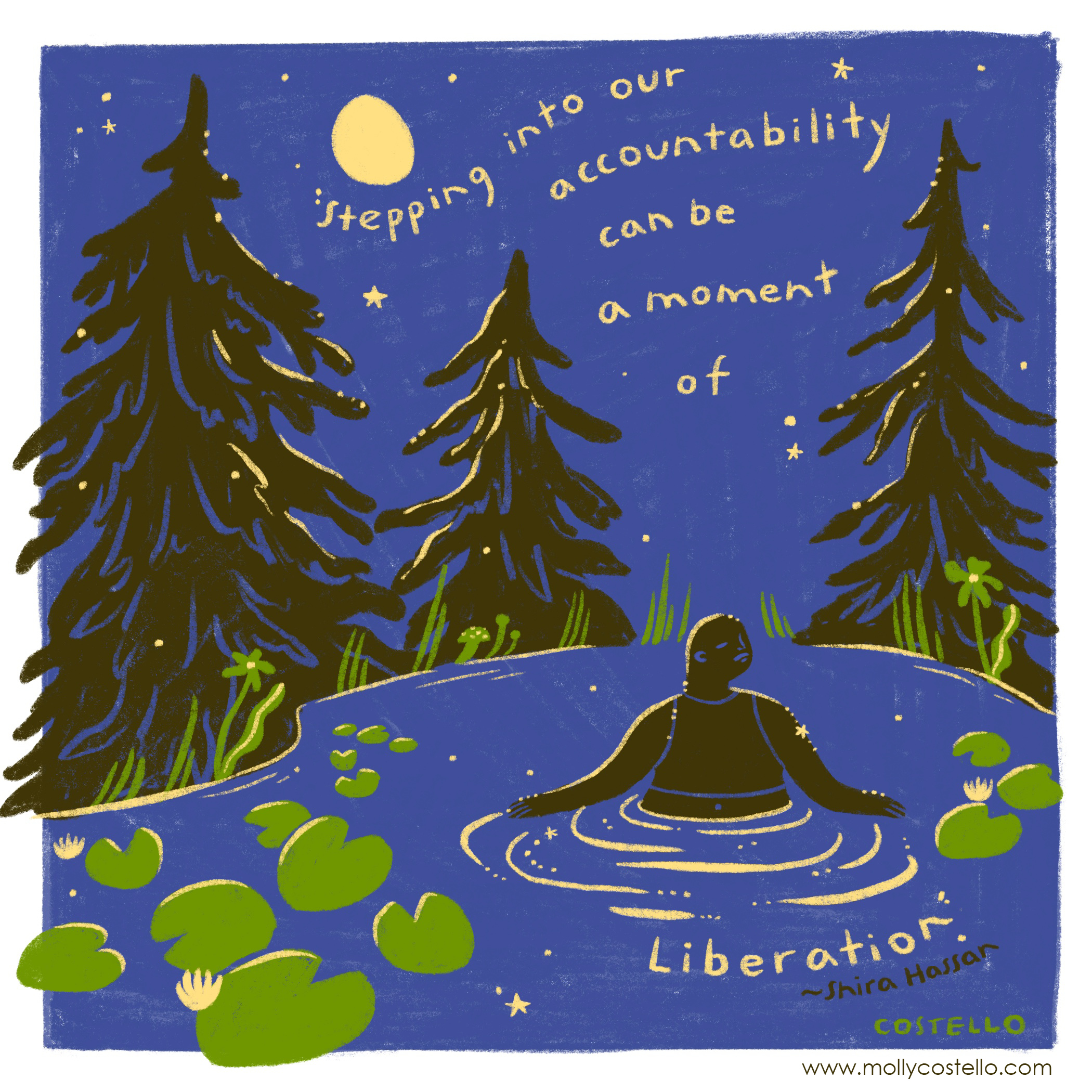
I like the provocation of this quote… even though I don’t fully understand it. I mean, isn’t liberation getting away with something? Isn’t the true taste of freedom what you get when you have no shackles, no responsibilities, no obligations, no consequences to worry about? When you can just do whatever the heck you want, and damn the rest of you!
I am drawn again and again to the image itself, of a silhouette wading into a beautiful pool of water, under the moon and stars, lily pads bobbing around, trees dancing witness by the water’s edge. And the image pulls me again and again back to that phrase… of stepping into accountability as the moment of liberation.
It’s kind of a family joke at our place that I’m not very good at apologizing.(For the record, I think I’ve become pretty good at it since it was first diagnosed as a character flaw by an astute life partner. And I literally have made a study/exploration of it. But. There it is. Sorry will probably never be the first thing I think to say in a moment of conflict or discomfort.) That said, making a genuine apology (stepping into my accountability for how my actions or words have affected someone) has definitely been liberating… it has liberated me of my defensiveness, my blaming, my clenchedness, my resentments… it has helped me soften towards the other person (“oh, i was trying to be funny but you heard it as mean and hurtful, i don’t want you to feel made smaller by me… i am sorry, how can i make it up to you?”), and moved me towards exploring what a gesture of repair might look like.
I don’t think I’ll ever find it easy. But I appreciate the feeling of lightness and connection that follows, after I wade through the yuk of it…
Sometimes, I look around the place where I live, where I have lived for more than 20 years, and think about some of the impacts that make me uncomfortable throughout the Sea to Sky corridor – boundary expansions and property developments – and how some of the people who were instrumental in making those things happened, no longer live here. They moved away. As many people do. It’s part of the ebb and flow of modern life. Not many people stay in one place forever, for their whole lives. In fact, it almost feels as if you’re out of step with the culture if you do. But many of them are no longer living daily with the consequences of their impact.
I remember reading about a community consultation that took place, people speaking about the impact of some intrusive development – a pipeline or a mine or fracking – and all the non-indigenous community members who were concerned about the impact of the proposal said “this will ruin this place and we’ll have to move away.” And the Indigenous leader speaking for the Indigenous community said, “yes, this will ruin this place, but we won’t move away because this place is us.”
And I wonder, what accountability do you have to a place if you always have the option in your mind of leaving? Of cashing in your chips, and going and finding someplace better/cleaner/nicer/more gated/less ruined/unexploited? Some place that so far has escaped the consequences of other people’s impacts…
And what happens when we reach the end of Other Unimpacted Places to Go?
What if, any developments had to be done by someone who was then tied forever to that place and could not leave, could not send their kids off to school or to live somewhere else, someone who had to live, and have their kids and grandkids live downstream of the precise place-based consequences of their impacts? Would you really green light that gold mine and have your kids swim in the tailings pond?
What if we were all accountable to the place we are? And could not move away from the consequences?
How differently would we behave… ? What pace would we move at? What different choices would we make? How would we soften? Who would we make amends with?

 The Wellness Almanac
