
Spotted by local bird expert, John Tschopp, dropping by for a visit last week, for a good feed of Upper Meadows worms, on its way north: the long-billed curlew.

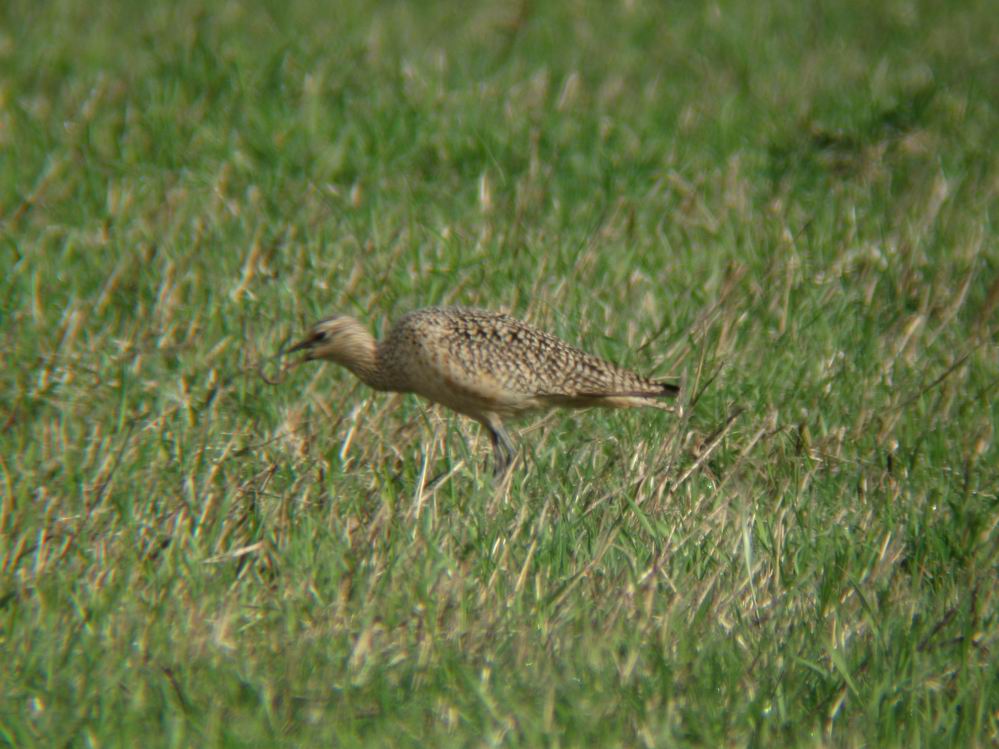
The long-billed curlew is the largest nesting or regularly occurring sandpiper in North America, also sometimes called the sicklebird or candelstick bird.
Back in 2005, Whistler birders noted their first sighting of a long-billed curlew ( Numenius americanus ) of the Sandpiper family – recorded by Karl Ricker in the Pique.
There, Karl writes:
Once viewed, never forgotten, the exceedingly large sickle-shaped bill gives the bird almost instant identity. There are four other species of curlew in North America but two are Eurasian strays, while the others are much smaller than the Long-billed and they are characterized by black stripes on their heads. The Long-billed is a plain-Jane cinnamon brown, and is 50-65 cm in length, the bill being about 40 per cent of the total! The wing-span extends up to 90 cm — a miniature version of the Concorde jet in landing mode is an appropriate inanimate comparison.
The Long-billed curlew normally migrates through the southern interior of the province in March-April from its wintering grounds in coastal USA and Mexico to three breeding areas in British Columbia: the Chilcotin-Cariboo centred at Williams Lake-Quesnel, the Thompson-Okanagan valleys from the U.S. border to Clearwater, and with less numbers to the Columbia River watershed from Cranbrook to Windermere, on the east side, and Creston to Revelstoke on its west.
The prime habitat is short blade grasslands which, due to agricultural developments, have markedly decreased the preferred habitat over the last 150 years. Hence, the populations have decreased and the bird is now “blue-listed” by the Conservation Data Centre at Victoria. The prime breeding areas are Akali Lake (SW of Williams Lake), White Lake (NW of Oliver), Douglas Lake ranchlands, and the upper Kootenay Valley from Kimberley to Windermere.
By mid to late July the young are fully-fledged and the outgoing migration takes place in early August with scarcely any birds left to be seen by mid-month. They migrate in small flocks, single file, and can be recognized by their “curlee” calls while airborne.
There are also non-breeding Long-billed curlews in the Fraser Lowland in all seasons of the year, though very few in winter. Sightings there usually warrant a “Bird Alert” by the Vancouver Natural History Society and, indeed, seeing one is a very special privilege.
The lengthy curved bill of the curlew poses dietary questions: what can they possibly eat with such an awkward contraption? Surprisingly, in summer months they pick off insects, beetles and other larger-sized arthropods. In winter, where they range on mud flats, salt marshes and farmer’s fields, they actually dig for invertebrates, including crabs and other crustaceans. Picture a culinary expert using chop sticks; the curlew is their avian counterpart.
How many years will lapse before we see the curlew again at Whistler? Probably many, but Pemberton Valley, with its better habitat, is long-overdue for such a sighting. So, have a good look there.

 The Wellness Almanac